
Where’d all the context go?
A manifesto for taste and context.

The content balloons don’t have strings. They float into our feeds, our For You pages and Pinterest boards, and they deliver us something. What? Whatever is in front of you. From where? It’s your job and your will to find out.
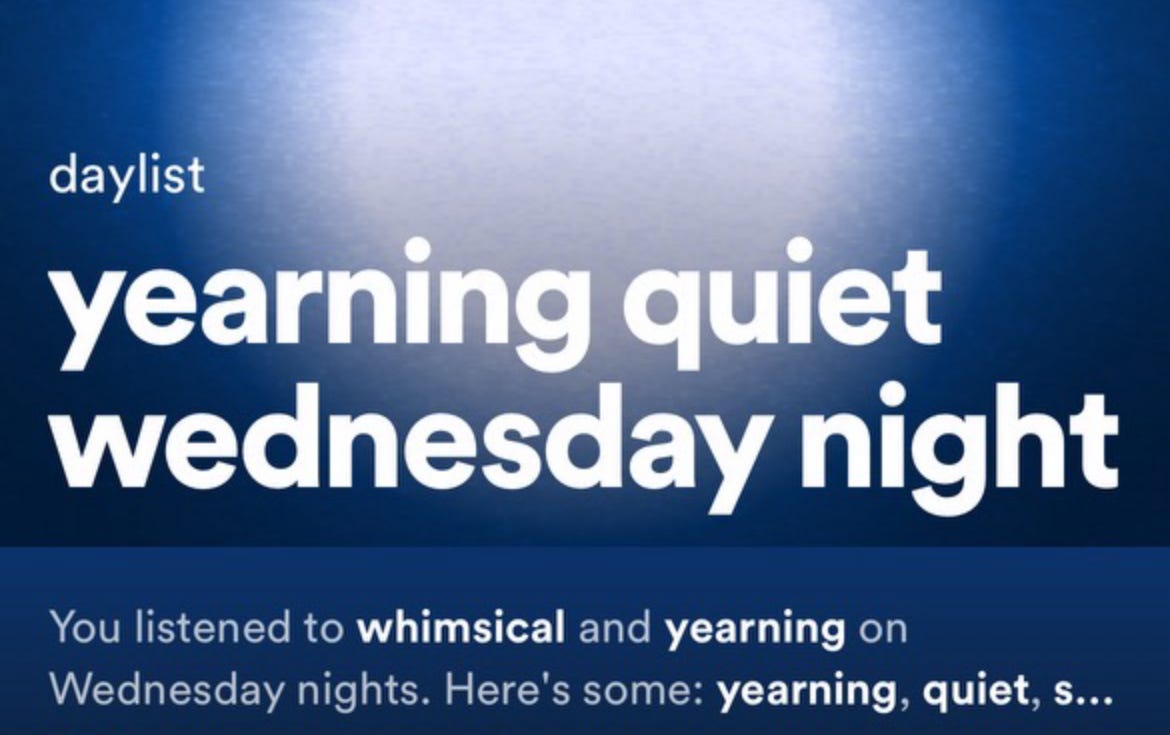
I get recommended songs on Spotify that I should like, algorithmically, in theory, and they present themselves to me in a playlist with a name that resembles something a human would say if a human weren’t a human at all, and I sift through the computer-generated playlist muck, one after another and another, and I listen to nothing.
You can’t jump and grasp for the balloon string, nor can you figure out how the balloon got to that very oddly shaped crevice. It’s up to the gods behind the computer, the ones who don’t know us. But, boy, do they know our data. They know I listen to classical music in the morning and that one song that got popular on TikTok and that one indie rock album from 2007 and Beyonce and Lana Del Rey and Sampha and that one Waterboys song. And they try so hard to appease me, to offer me the same songs that I have established I have liked through continual listens and they fail when they think I want to listen to another artist who sounds exactly like Lana Del Rey, because enjoyment is abundance to these computer equations, and rarely is it surprise or delight.
The Spotify algorithm doesn’t understand that the reason I like Lana Del Rey is because I think she is as funny as she is smart, and that she portrays womanhood in the most familiar form that I know, and because “American” sounds like skipping down the steps of the Smith 9th Street subway station to spend the day with a guy who will send me a paragraph text rejection a month later, and because I like how loud she screams in the chorus of “Dealer,” and because of that one line in “Sweet Carolina” where she rhymes “lilac heaven,” “iPhone 11,” and “fuck you, Kevin.” It’s not because I’m sad, which I sometimes am. But if I were sad, I wouldn’t listen to a playlist called “sad girl starter pack” (major emphasis on the lowercase letters, in case that was missed upon first read), even if every single one of my favorite Lana Del Rey songs was on it.
The reasons I choose the art I like can be formulaic, sure. But they are also deeply personal, sometimes political, and many times enigmatic. And they heavily rely on this sense of taste and broader context, the through-line that explains the “why” behind it all.
I want to talk about context in the digital age, the very necessary thing that gives us the taste and perspectives we hold, and the risk we run through the advent of modern technology that erases it.
Curation devoid of context
The digital town square that is the internet has moved in the direction of curation devoid of context. We are wearing things and listening to music and putting products on our face and eating at average quality restaurants that we don’t know anything about, besides the fact that we saw it on Instagram, or TikTok, or Twitter, or Pinterest.
And there’s this funny dichotomy that has blossomed with these behaviors: members of Gen Z, my generation, are hyper-focused on a sense of individualism and personhood and also want to be culturally and socially aware. But the platforms where they learn how to dress, how to talk, what to listen to, what to watch, what to read, where to eat, and what to buy often fail at providing them with the necessary context, leaving many of them more ignorant than they are informed.
It reminds me of this essay I read a few years ago from Pitchfork, on the woes of the modern music-streaming era, on the idea that when we subscribe to Spotify or Tidal or Apple Music, we’re not paying for the music itself, but rather “the opportunity to witness the potential of music.” Jeremy D. Larson laments the knowledge that listeners lose through the magical and computer-curated playlists the streamers offer:
“Spotify’s radio station for Ludacris’ “What’s Your Fantasy” doesn’t link to any OutKast songs, even though I watched Ludacris open for André 3000 and Big Boi when that song was released in 2000, and both acts are from Atlanta. Is Spotify aware that Big Boi is a huge Kate Bush fan? Does Spotify know that singer-songwriter John Darnielle of the Mountain Goats is a metal head? If you have seen Darnielle cover metal bands from Dio to Gorguts to Nightwish, or are familiar with one of his most popular songs, “The Best Ever Death Metal Band Out of Denton,” you know that he loves some sick riffs and moonward barks. But all of that intimate (and publicly available) knowledge is lost to machine learning. Tuning into Spotify’s Mountain Goats’ Radio won’t turn up any Dio at all—just literate and mostly acoustic indie rock songs that sound similar to the Mountain Goats. Left to a streaming service, these kinds of textured and unique connections are smoothed over or erased entirely.”
It’s not just social media platforms or streamers – it’s also our search engines, the vehicles for acquiring information itself. We are seeing in real time generative AI completely alter the way we find information on the internet. Google’s Bard, OpenAI’s ChatGPT, and other AI-powered assistants that can deliver targeted, data-driven, and personal search results to a user could replace or at least fundamentally alter traditional search engine tools.
There’s two issues with this development, however: large language models in their current form have a tendency to hallucinate, plagiarize, and fabricate information. And when they do offer correct information up, where and how they came up with the answer to the query is difficult to track and understand. Developers and computer scientists are trying to fix this, given how contentious the issue is, but many doubt that they can fully eradicate hallucinatory behavior.
Taste as a superpower
Context has never been as important and taste as paramount in our digital landscape.
We’re seeing a real shift and growing interest in this development of taste as our recommendation channels are flooded with alienating algorithmic content.
You can see it specifically through the lens of personal style, one of the purest forms of outward and inward taste. Even as more clothing and micro-trends are pushed onto platforms at lightning speed, personal style and this idea of wearing clothing that could ideally last you a lifetime persists. Anecdotally speaking, most if not all of my friends have talked with me within the past year about curating their own sense of style and buying high quality clothing pieces. It feels like we’ve reached a content saturation point where the only way out of this abundance is through reversion.
Taste becomes a superpower, “an act of resistance against what these algorithms and age online is doing to us,” Ezra Klein says in a recent podcast episode. “It feels like being able to be attuned enough inside yourself to know what you really like — not just what you’re being fed. Being attentive enough to the world around you to see things that are really yours, not just everybody else’s.”
Finding your own taste can be an exploratory form of introspection. What do you actually like when an algorithm isn’t offering you something? What do you gravitate towards? What themes in movies, music, and books compel you? Who are your heroes, and who are your heroes’ heroes? What book inspired your favorite scene of your favorite movie? Through the curation of taste you can find this out – but you can’t rush the process.
Curating taste, in my eyes, is like tying strings on our balloons and controlling where they float as an act of personal autonomy. It’s a form of grounding ourselves to the tangible and the human.
“When I think about the value of curation, it’s not just telling you about what to consume, it's giving you this holistic education and insight into how things work into the context of objects and ideas,” Kyle Chayka says on Klein’s podcast. “It involves vast amounts of labor and time and work to present objects or ideas or songs or whatever in the context that they deserve.”
Art, objects, ideas, food, songs. These are treasured resources that have decreased in value through hyper-consumption. The will for curiosity and the belief in these products as a source of good can function as a form of resistance against the technological powers that be.
…
Thank you for reading! Hopefully I didn’t meander too much. If I did: oh well. To learn more about my new content schedule, which includes a monthly essay like the one you just read, visit my recent post.