
Notes on the Mariko-verse
What happens when your content is viewed by 500 million of your closest strangers?

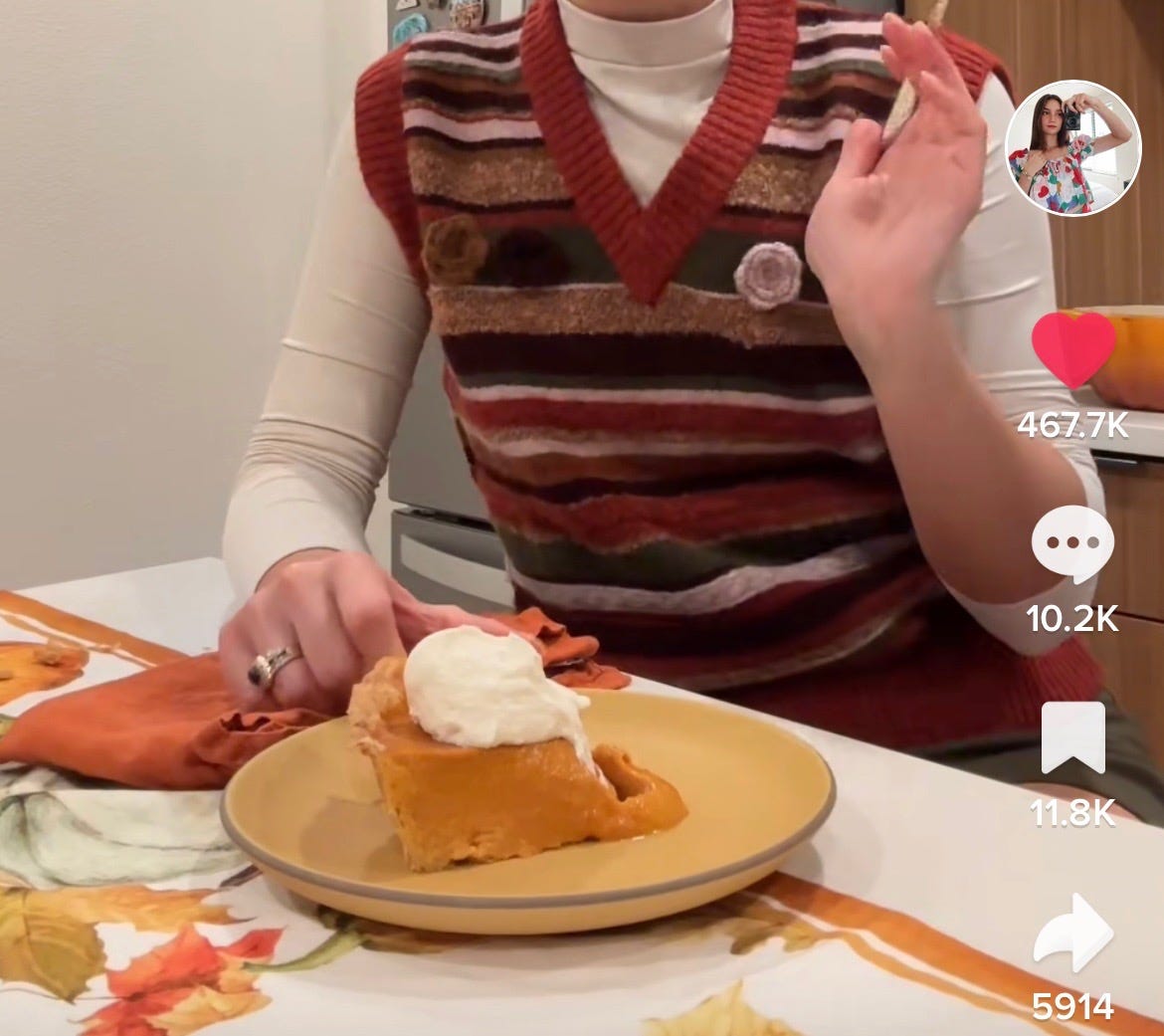
On Thanksgiving, Emily Mariko made a pumpkin pie.
To the average American this is typical, perhaps, traditional. And a traditional pie it was—Mariko, per her newsletter, says she adapted it from a 2010 America’s Test Kitchen recipe. But if you went through the food and lifestyle TikToker’s comments on the video of her making and eating the pie, you’d think Mariko had just attended the insurrection.
The reason for this Thanksgiving TikTok hysteria concerned the viscosity of the pie. Most pumpkin pie recipes use the “jiggling” indicator to let home cooks know when a pie should be taken out of the oven. Recipe writers recommend that the center maintain a slight jiggle while the filling closer to the crust should stay in place. When she jostled the pie, Mariko’s filling was not a slight jiggle. You know when someone cannonballs into a swimming pool and makes such a large splash that the water oscillates from one end of the pool to the other? That was the sort of jiggle we’re speaking of. It was a viscous pie! She sliced into it, and, in the words of the late Joan Didion, the center was not holding.
Somehow, this became everybody’s problem. There are 10,000-plus comments on that video, and most of them make some variation of the “medium rare pie” or “soup” joke. The TikTok, as of this writing, has almost eight million views. Many of the comments take her baking faux pas and meme-ify it, but the joke has gone on for far too long.
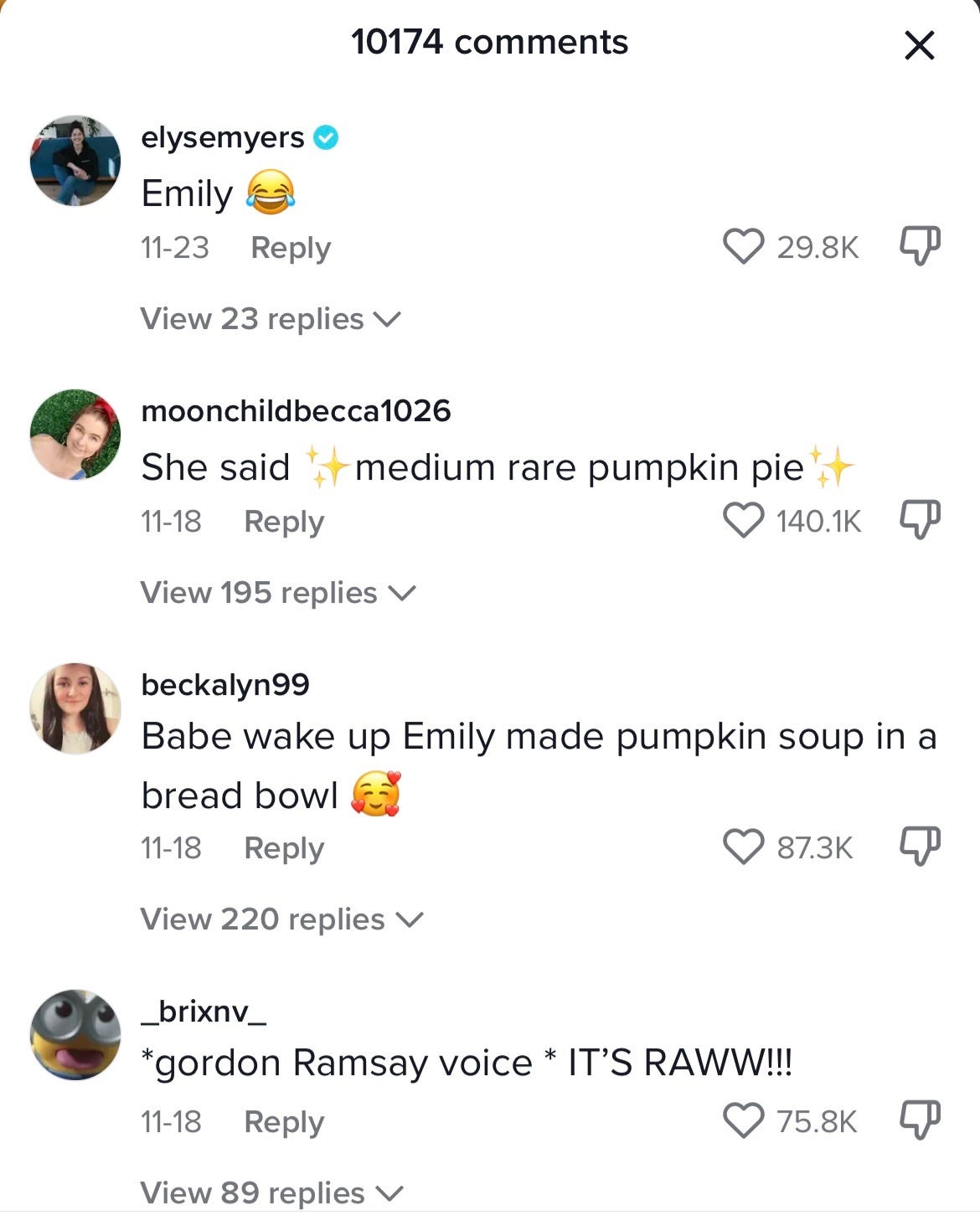
She has posted 22 videos since that pie TikTok. Thanksgiving is over. But. I. still. see. comments. requesting that Mariko address the pie video. As if it matters! As if she just leaked the Pentagon Papers. Girl. It’s a pie! If I had to record and post every meal I made for myself, y’all would see a lot of accidentally burnt pieces of toast. And if I had to make a video and address every time I ate a burnt piece of toast, well, I would rather not have a digital presence at all.
—
This isn’t the first time the tectonic plates of TikTok were moved to a category five social media earthquake by an Emily Mariko recipe video. In July, she posted a video of her making lemon pasta. Lemon pasta!!! The recipe came from a famous New York Italian pizza and pasta joint called Lil Frankies. Excluding the salt in the pasta water, the ingredients consisted of butter, spaghetti, parmesan, and lemons. Mariko follows owner Frank Prisinzano’s recipe to a tee.
Nevertheless, duets, comments, and stitches criticizing the recipe abound. One commenter wrote, “This was the last straw. I’m done.” It wasn’t some grand offense; Mariko had simply cooked a dish that didn’t seem “right” to her millions of viewers. With its minimal ingredients some commenters pointed out the recipe’s lack of seasoning—a joke the internet has clung to despite its harmful cultural and racial binary in an attempt to delineate between “good” food and “bad” food—as a justification for why the lemon pasta felt off. After her viewers uproariously caviled the recipe, they again requested that she come forward, address the pasta. I’ve seen thousands of critical comments on her videos and far less videos attempting to remake these recipes or produce content of the same caliber.
Her addressing her recipes is exponentially hilarious when we consider the TikToker in question. Mariko, ever since she rose to TikTok fame through her viral salmon rice bowl that caused a Kewpie mayo shortage in grocery stores, has more-or-less made her recipes on TikTok and minded her business. Rarely does she directly address the viewer in her TikToks. Most recipe videos are made without dialogue, and she doesn’t interact with her viewers in the comments. The only time we hear her talking to us in her TikTok content is when she walks us through a farmers market haul. She’s not divulging her daily routine or her relationship struggles to her followers. She shares the recipes she makes on TikTok through her weekly Substack, but leaves most of the details of her life up to the imagination.
Before her TikTok fame, it was different. Mariko was originally a YouTube vlogger, and as I perused her old YouTube videos pre-salmon bowl fame, I found a different Mariko. This one was bubbly and smiley and divulged her routine, her goals for the day, the trips she took with her then-boyfriend.
—
In a TikTok landscape bumbling with pseudo-experts, chauvinistic male chefs who begin every recipe video by throwing a sharp knife at a butcher’s block, and food personalities hell bent on showing you the proper way to chop an onion, Mariko is one of the few successful food TikTok figures who exists on the outside of the genre’s exhibitionism. She is a home cook through and through. Sure, she’s cooking for us. I mean, the camera is on and we are watching. But you won’t find that food-porny pizzaz or haughty expertise that other creators try to inject into their content in one of her videos.
Through her artisan plates and Le Creuset pots and ceramic knives and farmers market hauls she is allowing us to peer into her life and see the casual luxury afforded to an influencer through the daily meals that she enjoys making for herself. Her TikToks are so relaxed, so catered to her diet, that she tends to post herself preparing the same (or similar) meals multiple times a month, because that’s the sort of food she likes. It’s a nonchalant refusal to the ever-churning food content machine that requires creators to always give viewers something they haven’t eaten or seen or heard of before. She’s got nothing to prove and she knows you’ll watch one of her TikToks regardless.
Those brief three minutes of meal preparation and the post-bite smirk is all we get out of her. We don’t know how the food tastes. We don’t know if she enjoyed making the recipe. Where other TikTok food celebrities sell the recipe they’re creating through their forced hipness, their quippy monologues that relate to the recipe at hand, or their snappy hot takes on ingredients, by comparison, Mariko is selling casual-but-effortful California minimalism with a full emphasis on the food she makes, the ambient and calming vibe of her meal preparation and kitchen, and not as much on herself as this all-knowing food personality figure.
—
Her strategy of posting her lifestyle content and minding her business has worked. She has 12 million TikTok followers, after all. The salmon rice bowl TikTok cascaded her into the food TikTok hall of fame, and through this overnight recipe sensation, she has brought along followers that may or may not have such an ardent interest in home cooking. Virality seems to do that.
Another unwieldy internet beast TikTokers have to reckon with is, inevitably, the platform itself. Unlike Instagram and Twitter, where a majority of the content we see is determined by who we follow, TikTok functions off an algorithm that introduces you to videos through a For You Page. Algorithms determine what you see and who you follow does not (although your interests, your friend’s interests, and a ton of other identity data plays a large role in what pops onto your FYP). Ultimately, I have no control over who sees my TikToks: I could include the appropriate hashtags and follow the right people, but the rest is up to the gods. I once posted a TikTok about the cold Minnesota winters and somehow it found its way to some random guy in Texas who has never stepped a foot into the state.
So let’s take that algorithm and think about how recipe content from a TikToker with over 12 million followers will find its way onto the FYPs of people who have maybe never cooked a meal for themselves, and they all have their own opinions on what is the “right” and “wrong” way to prepare a dish, and they all want you to know that you’re making it wrong—whatever you’re making! it’s wrong!
This is what happens when your content is viewed by some 500 million strangers on a platform that doesn’t reward nuance, expertise, or positive engagement. It causes me to wonder: how much can we give to our millions of followers and viewers when they don’t take the time to understand the work we create, the food we enjoy, the origins of our recipes, the humanity of our errors? TikTok and social media at-large doesn’t allow for these complex and supportive relationships between creators and viewers to blossom. There is a possibility of a symbiotic relationship between the two, but more often than not, creators are bombarded by vitriolic-at-worst and irritating-at-best reactions when their content isn’t picture-perfect.
I like to think of a social media post as the first act of a ballet performance. The interactions you have with your followers who comment on or share the post, on the other hand, is like the final curtain call when the ballerina comes out as themselves after the show concludes and bows to the audience. Mariko hasn’t made this curtain call. Because she does not engage with her swaths of TikTok followers—it would be impossible to meaningfully do so given the circumstances— she is perpetually stuck dancing for her audience, keeping her thoughts and reactions to her viewers’ comments off camera. But isn’t that a good thing?
In the comments of Mariko’s pumpkin pie video on Instagram (she relays the same video to both TikTok and Instagram), a user by the name of @peanutsarethesuperlegume said that they attempted this recipe last year, and their pie would not set without baking it for longer than what the recipe suggested. After all of this hullabaloo, the pie was a failure on the recipe developer’s part, not Mariko’s. But Mariko got 10,000 comments worth of flak.
Now is a good time to note that Mariko is no victim. She evidently doesn’t care enough about these comments to cease posting or apologize for her off-putting-to-some recipes. She’s living in California in a beautiful apartment and dining at the French Laundry with her fiance. She’s good. Still, she has established a partition between herself and her viewers for the sake of her privacy and her sanity.
Emily Mariko’s TikTok followers will never know her. They will only know of the avocados and eggs she eats for breakfast and the kimchi stews she makes for dinner, never more and never less. But on a platform where content is consumed as quickly as it is forgotten, knowing anything or anybody was never the point in the first place.
…
Thank you so much for reading! This was such a fun article to write and an idea that has bounced around my head for a few days. It’s nice to get it out and complete the thought. Hopefully you enjoyed.
Things I’m Loving
“Wede Harer Guzo” by Hailu Mergia and Dahlak Band: This is an instrumental album I have been listening to as I work. The songs on the album have an ambient funk to them that pair wonderfully with menial tasks.
New Season of “Gossip Girl”: This season looks MESSY and I am so excited for it. On one of last week’s episodes Substack and pop culture writer legend Hunter Harris made a special cameo. Finally, the Substack newsletter writer representation these juicy dramas were lacking.
Keith McNally’s Instagram: Maybe I hopped on the Keith McNally bandwagon as the James Corden-Balthazar beef was buzzing, but McNally has stayed on my Instagram algorithm well past the celebrity dining drama because his presence is so chaotic, dilapidated, and FUNNY. McNally owns a bread basket of scene-y New York restaurants, so he’s always reporting on city notables who dine in, impolite guests, and other daily antics. After following him for a few weeks, he seems to treat his very public and infamous Instagram as though it’s a private spam account, and I respect that verve in 2022 when the dominant trend on Instagram accounts is disengaged aloofness. McNally spares no details.
White Lotus season finale this Sunday: I’ve seen so many fan theories that I feel like I don’t even need to watch the finale to know how it ends. Nevertheless, I will eat it up this Sunday.